Tuckory.Websites · Content · AI-Assisted Systems

Work

The portfolio is the work itself.

Five pieces of our own work, and one separate publishing library, each described with its scope stated plainly. We do not publish client names, testimonials, or results we cannot show, so this page shows what exists and links to what is live.

What you can check yourself

See it for yourself.

Each claim on this page points to something public, dated, or stated with its limits. Start anywhere.

01 · Live site

Visit focuschrist.com

Live since March 2026. Inspect the pages, artwork, timeline library, and Ask system yourself.

Open the site
02 · Sources shown

See reviewed answers serve

Over 200 reviewed answers serve first on Ask, with their sources shown.

Try Ask
03 · Dated record

Read Sunflower plainly

Designed and built June to September 2026, used in daily sales work for about three months, then retired when a newer tool replaced it.

Read the entry
04 · Live tool

Run the ToolProwl planner

Answer a few questions and watch explicit decision rules turn them into a plan.

Open the planner
05 · Live tool

Run the AppNarrow audit

Answer questions about your current software and get a recommendation, with the evidence dated on the page.

Open the audit
06 · Separate library

Browse the writing samples

Eight guides, four comparisons, and two tools, kept in a separate publishing library with its evidence standard stated.

Browse the library
Live website + answer system

focuschrist.com

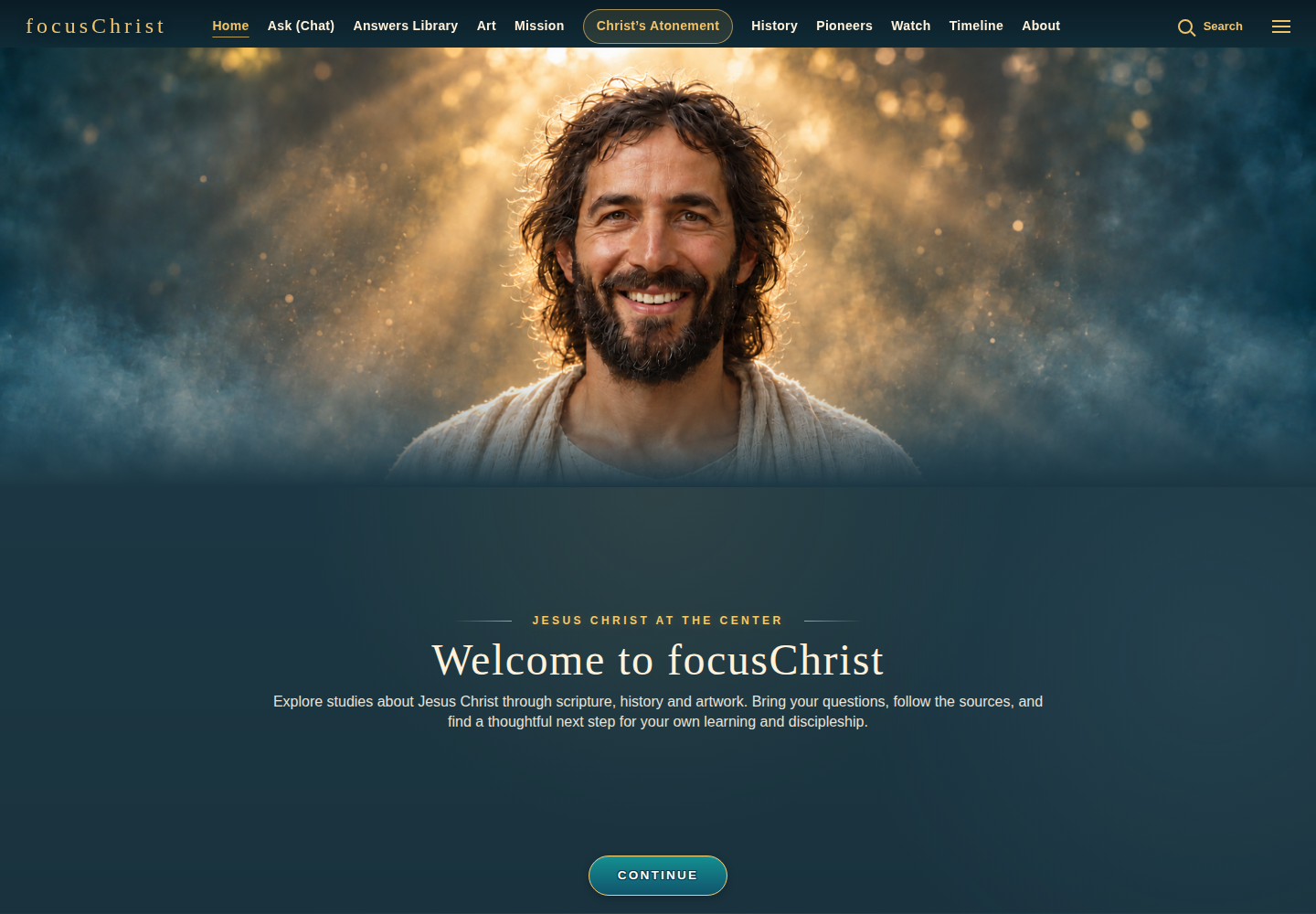
Screenshot of the focuschrist.com home page: artwork of Jesus Christ in golden light above the headings "Jesus Christ at the center" and "Welcome to focusChrist," with the site's navigation across the top, including Ask, Answers Library, Art, History, Pioneers, Watch, and Timeline.
The home page of focuschrist.com: Jesus Christ at the center, with studies drawn from scripture, Church history, and artwork. From here a visitor can ask a question, browse the answers library, or walk the timeline and pioneer pages, following the sources as they go.

A faith website about Jesus Christ and the restored gospel, designed, built, and maintained by this studio since March 2026. It is the largest single body of work we have shipped: a full content site with original artwork, a timeline library, and a question-answering system.

The answer system is the part we are proudest of. Questions are answered first from a bank of answers that people drafted, reviewed, and approved; each served answer shows its sources. Questions the bank cannot yet answer become drafting work: new answers are drafted by people, reviewed, and added, so the bank grows by review rather than by guesswork.
  • Design and build of the site, its pages, navigation, and artwork
  • Reviewed answer bank of over 200 answers, each checked before it could serve
  • Verification discipline: every release checked live across the pages it changes, never spot-checked and assumed
  • Ongoing: new answers, artwork repairs, and site improvements continue
  • Check it yourself: open Ask on the live site and see the reviewed answers and their sources

Visit focuschrist.com

Software, built and used

Sunflower CRM

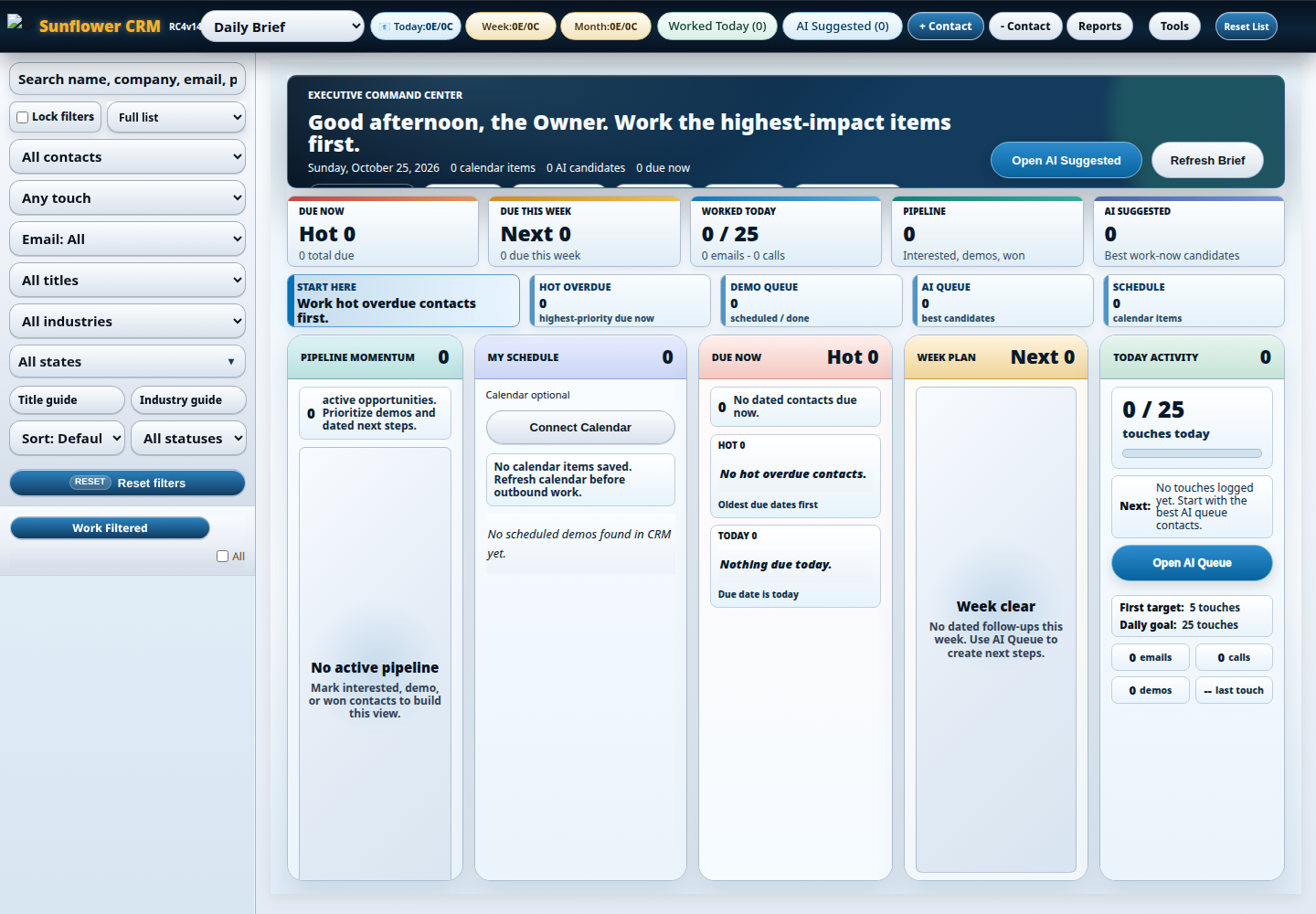
Screenshot of the Sunflower CRM Daily Brief dashboard in a fresh workspace with no records loaded. Counters for due now, due this week, worked today, pipeline, and AI-suggested contacts all read zero, and the pipeline momentum, schedule, due work, week plan, and today activity panels show their empty states beside a sidebar of contact filters.
The Daily Brief, Sunflower's opening view: the day's due work first, touches counted against a daily target, the week in one place. It is shown in a fresh workspace with no records loaded, so every counter reads zero. The records from its working life held real people's details, and those are not ours to display.
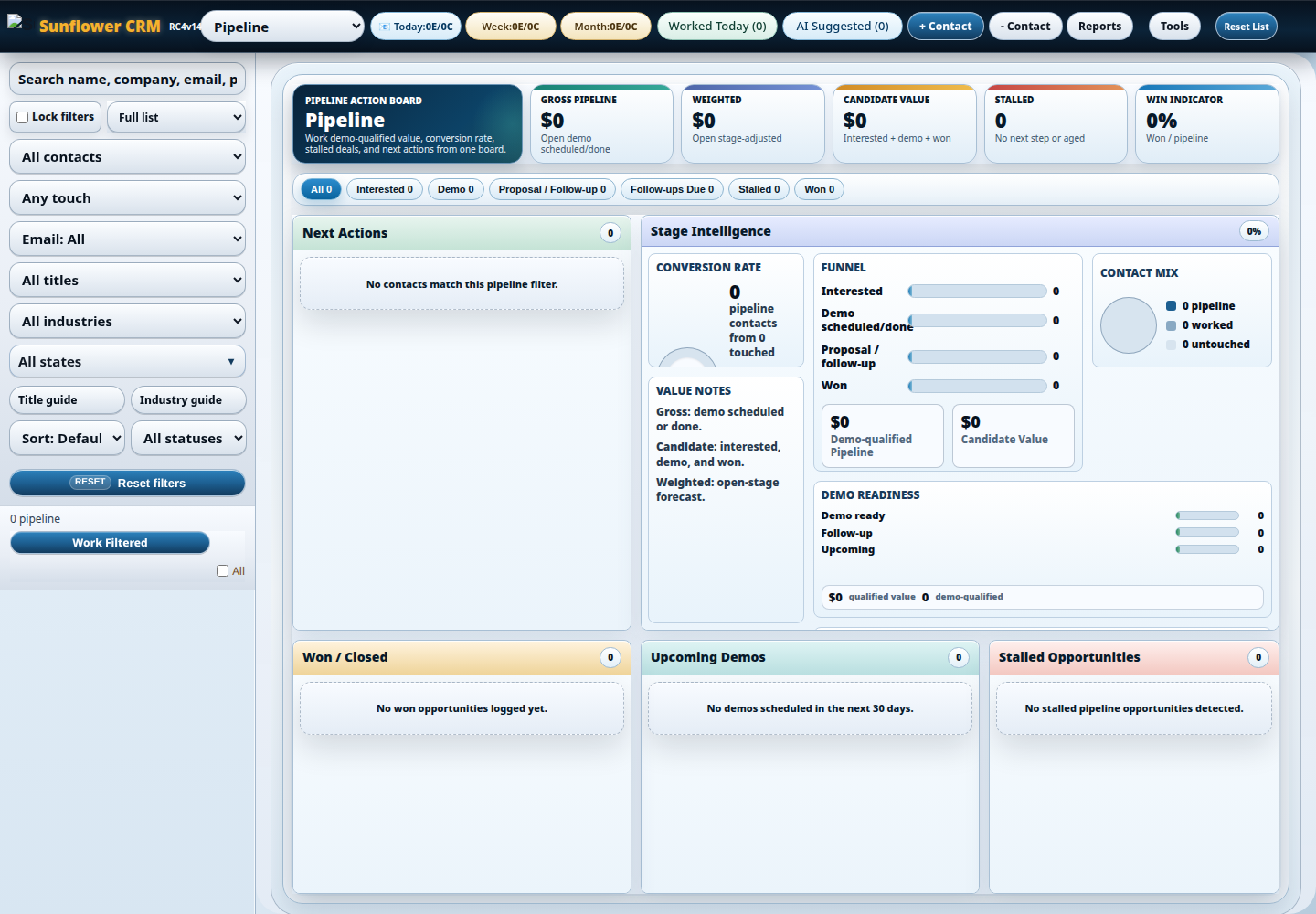
Screenshot of the Sunflower CRM Pipeline Action Board in a fresh workspace with no records loaded. Gross pipeline, weighted value, and candidate value all read zero dollars, the stage counts are zero, and the next actions, won or closed, upcoming demos, and stalled opportunities panels show their empty states.
The Pipeline Action Board: opportunities carried by stage, value weighted by stage, and stalled deals flagged for a next step. Shown in the same fresh workspace, with nothing in the pipeline yet, so every stage and every value reads zero.

Sunflower is a complete local customer relationship management system designed and built by our founder with his AI team between June and September 2026. It was not a demo: he used it in his own daily sales work for about three months, until a newer prospecting tool replaced it. The project was led by a founder whose background includes more than two decades in enterprise networking and sales engineering.

We describe Sunflower exactly that way, as our own build, used by ourselves, because that is what the record shows. It stands here as evidence that this studio can take a working system from an idea to something a person relies on every day.
  • Designed and built by our founder with his AI team, June to September 2026
  • Used in real work for about three months of daily sales activity
  • Retired honestly when a better-fitting tool replaced it, and kept as a record

The tool that replaced it

Software, built and used

The prospecting system

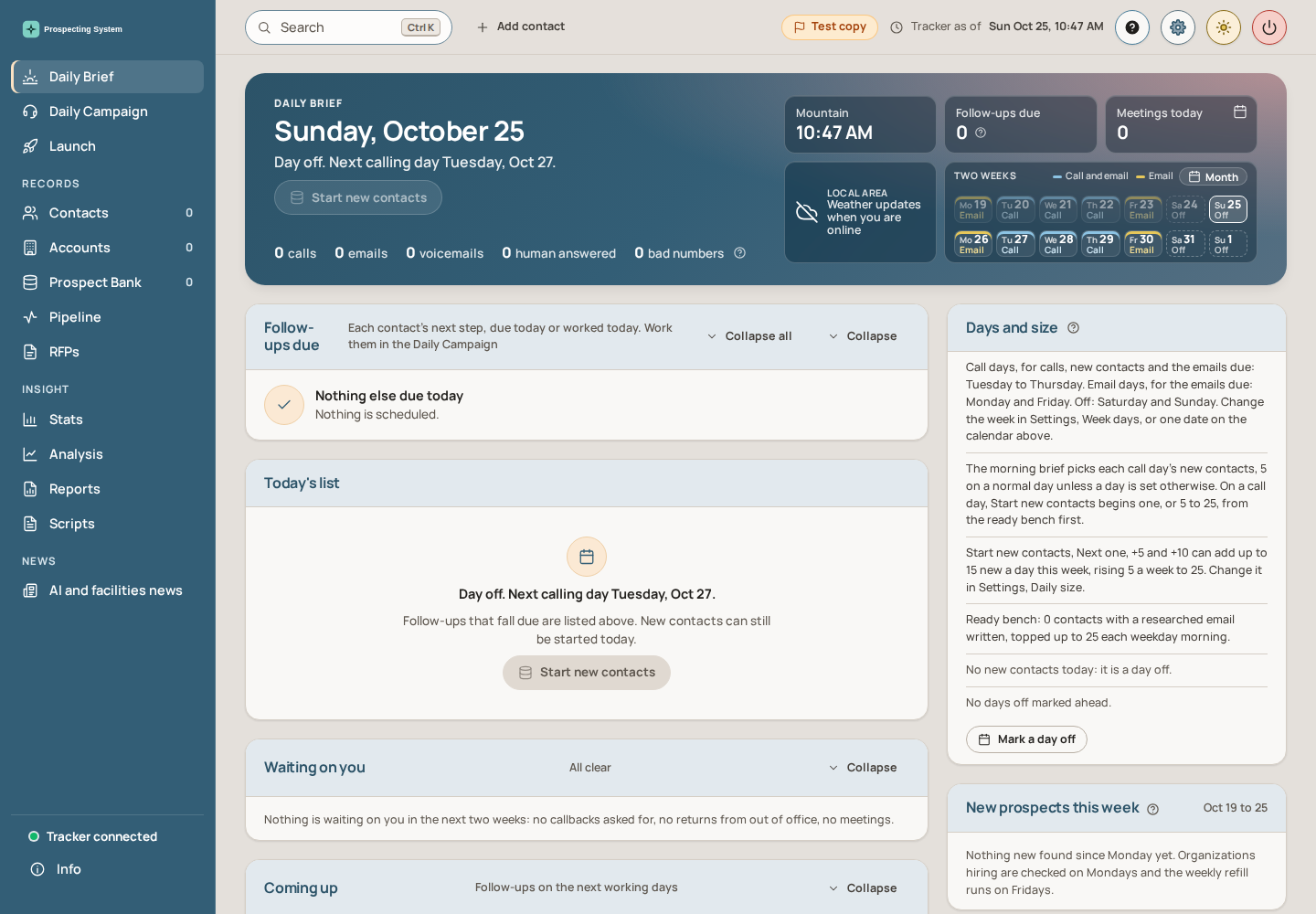
Screenshot of the prospecting system's Daily Brief in an example workspace: the sidebar shows Contacts, Accounts, and Prospect Bank all at 0, and the page shows Sunday, October 25 as a day off, with "Follow-ups due" 0, "Meetings today" 0, a two-week strip of call, email, and off days, and the counters "0 calls, 0 emails, 0 voicemails, 0 human answered, 0 bad numbers."
The prospecting system's Daily Brief, shown running on an empty example workspace with the original branding replaced. A fresh day starts here: follow-ups due, the two-week calling calendar, and the day's list in one place, with every counter at zero because nothing has been worked yet.
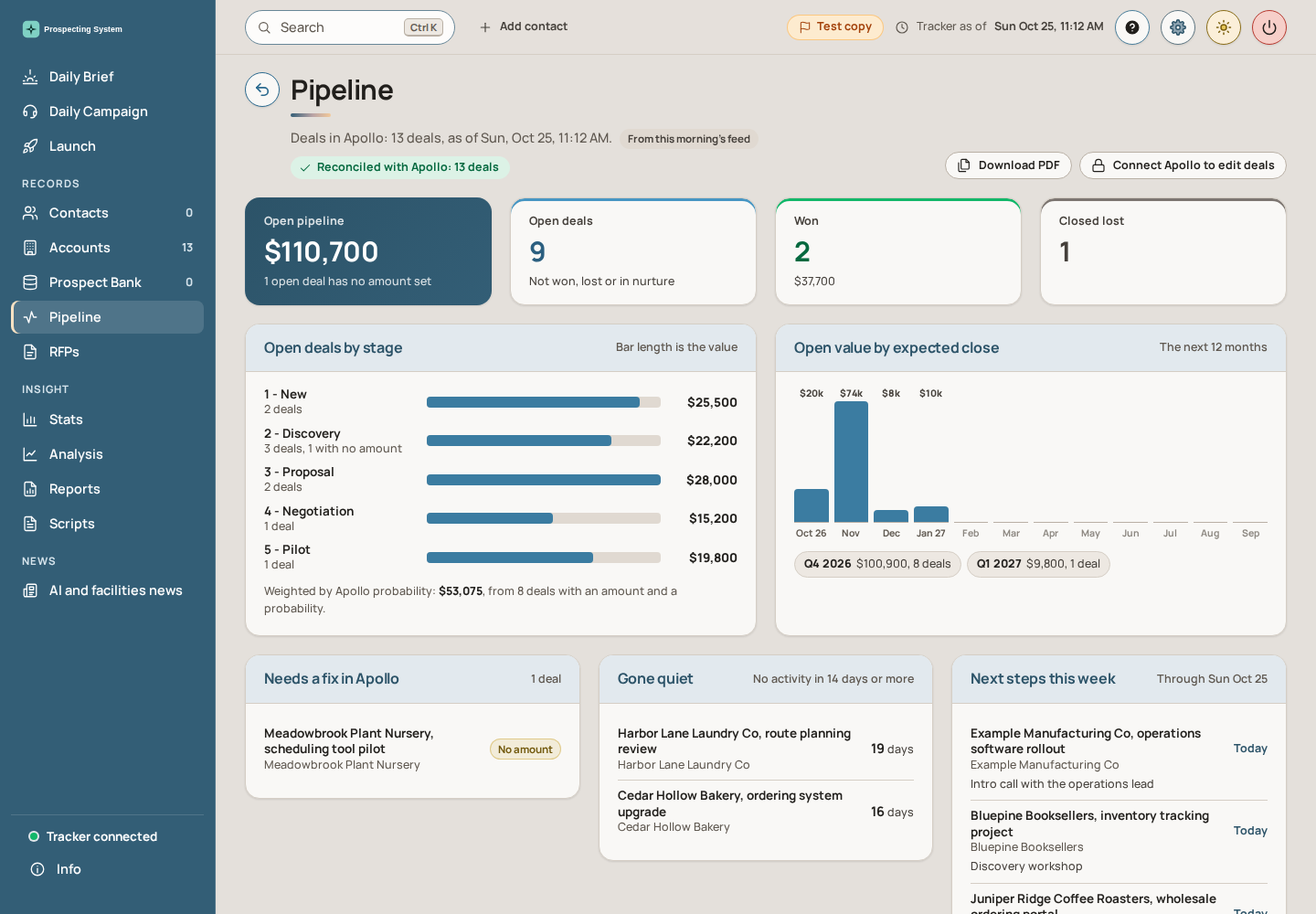
Screenshot of the prospecting system's Pipeline view as a test copy holding example data: the sidebar shows Accounts 13, Contacts 0, and Prospect Bank 0, and the page shows 13 example deals, with open pipeline of $110,700 across 9 open deals, 2 won for $37,700, and 1 closed lost, stage totals of $25,500 for New, $22,200 for Discovery, $28,000 for Proposal, $15,200 for Negotiation, and $19,800 for Pilot, and panels headed "Needs a fix in Apollo," "Gone quiet," and "Next steps this week."
The pipeline view of the same prospecting system, shown as a test copy with its original branding replaced, on example data created for this picture. Thirteen invented deals stand across its stages, nine of them open, with stage totals and an open pipeline value of $110,700; every name and figure is invented, not a real customer or result.

After Sunflower, our founder designed and built a second system for his own sales work: an AI-assisted prospecting system that he then used daily in real sales-development work. Where Sunflower kept the records, this system ran the prospecting itself: it decided what the day's outreach queue should be, checked work against a written standard before it went out, and kept the conversation history straight.

Its working parts were a daily queue engine, a pre-delivery rules checker, a conversational tracker, a library of scripts and sequences, and a local web app that put them in one place.

We show this system as experience, not as a product. It was built for one employer's work, so the tool itself and everything in it are not ours to display or sell, and none of it appears here. What it proves is narrower, and we think worth more: this studio can design and build a working AI-assisted system around a real job, one a person relies on every day. If a system like it would serve your own work, we can build one for you from the ground up, around your tools and your data.
  • Designed and built by our founder with his AI team
  • Used daily in real sales-development work
  • Five working parts: queue engine, rules checker, conversational tracker, scripts library, local web app
  • Shown as experience only: the original tool and its data belong to an employer's work and are neither displayed nor offered
Live website + tools · Our own product

ToolProwl

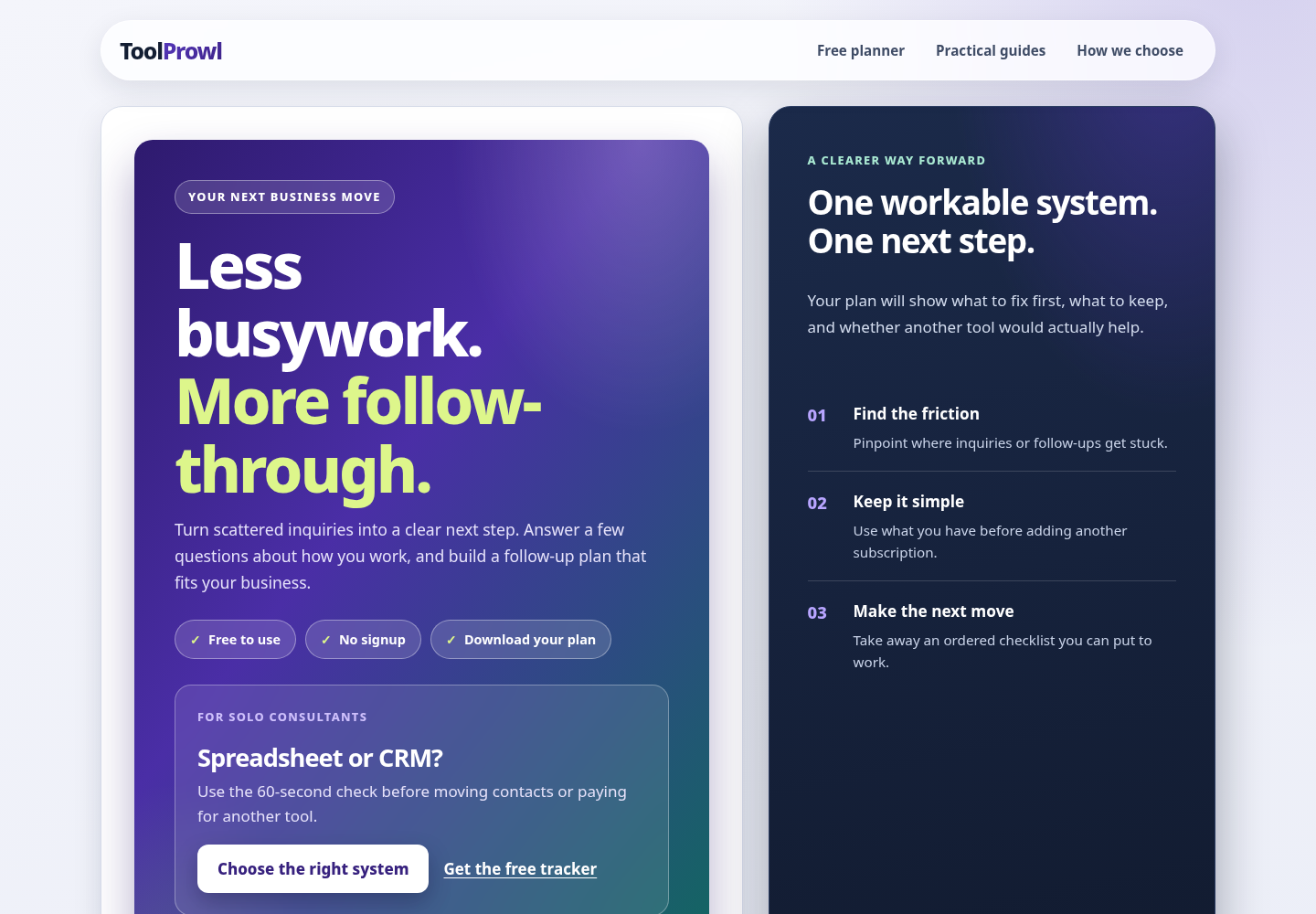
Screenshot of the ToolProwl home page: the heading "Less busywork. More follow-through," the free planner offer with the chips "Free to use," "No signup," and "Download your plan," the "Spreadsheet or CRM?" 60-second check for solo consultants, and a side panel giving three steps: find the friction, keep it simple, make the next move.
ToolProwl's home page. Its free planner turns a few answers about how a small business works into an ordered follow-up plan, with no signup; the page also carries the 60-second check that helps a solo consultant decide between a spreadsheet and a CRM before paying for another tool.

ToolProwl is our own publication for solo operators and small service businesses choosing the tools that handle lead capture, follow-up, scheduling, and proposals. It publishes practical guidance and a free planner, and it is not a shop window for client work: ToolProwl takes no client work itself, and a visitor who wants the work done for them is routed here, to the studio.

The planner is the working piece. It asks about your current setup and answers with explicit decision rules, including the unfashionable ones: fix the CRM you already have first, and treat low inquiry volume as an acquisition problem rather than a reason to buy software. The planner runs end to end on the live site.
  • Guidance and a planner for follow-up and CRM choices, published under our own name
  • Provider facts dated: product descriptions rest on provider information reviewed October 24, 2026, and the page says so
  • Relaunched October 25, 2026 with a new design, verified live page by page before we called it done
  • No client work: ToolProwl publishes guidance only; studio work routes to Tuckory

Visit toolprowl.com

Live website + audit tool · Our own product

AppNarrow

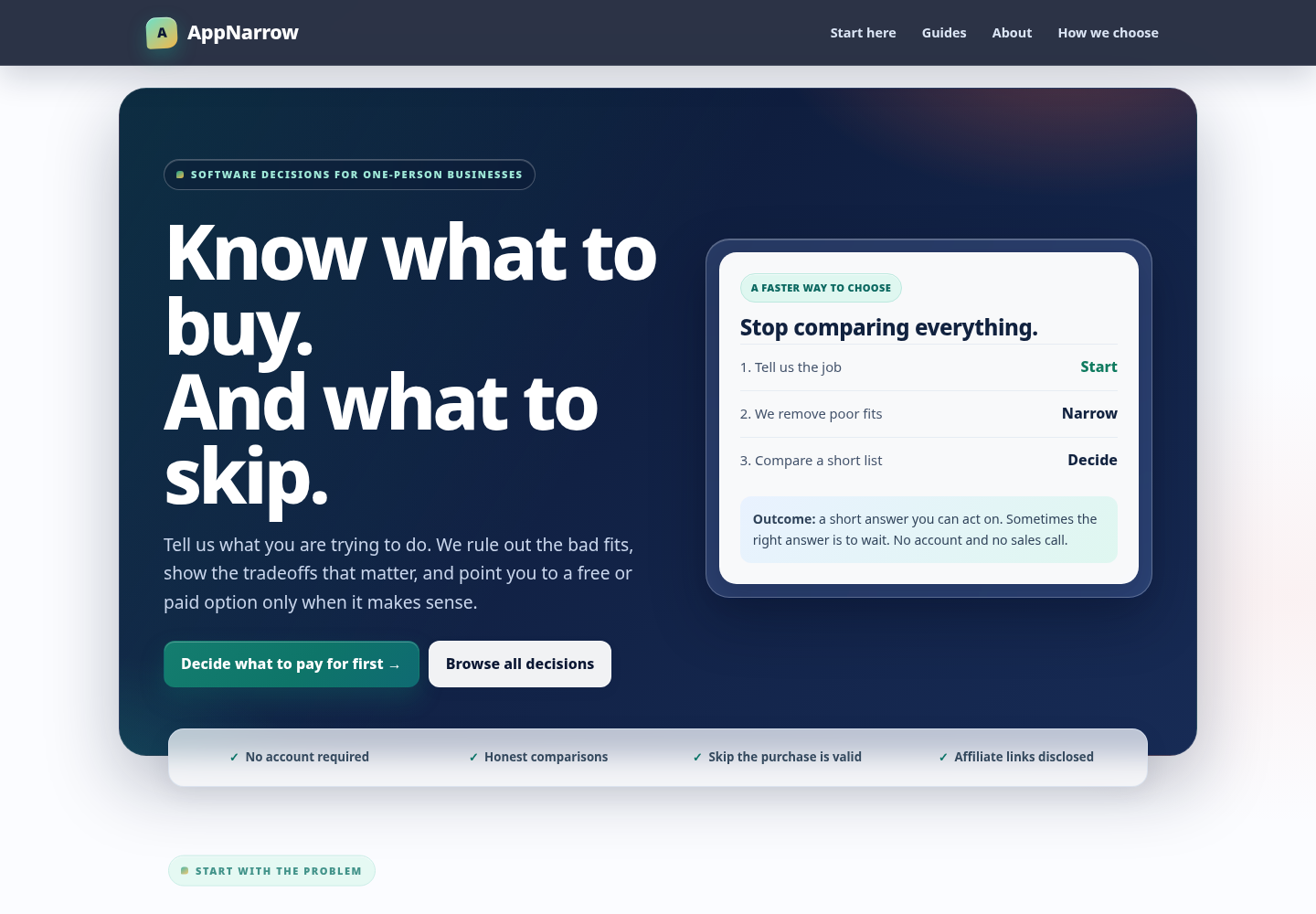
Screenshot of the AppNarrow home page: the heading "Know what to buy. And what to skip," a three-step card (tell us the job, we remove poor fits, compare a short list), and a trust row reading "No account required," "Honest comparisons," "Skip the purchase is valid," and "Affiliate links disclosed."
AppNarrow's home page. A visitor names the job they are trying to do, AppNarrow removes the poor fits, and what remains is a short list with the tradeoffs shown, including when the right answer is to buy nothing. No account is required, and its affiliate links are disclosed on the page.

AppNarrow is our own site for solopreneurs and microbusinesses facing a software decision. It starts from the job to be done, narrows out unsuitable categories, compares a small number of realistic options, and explains the tradeoffs. Buying nothing, taking a free plan, or choosing the smaller tool can be the correct answer, and the site is willing to say so.

Its working piece is an audit tool: answer a short set of questions about your current software and it produces a recommendation you can act on. The facts behind the comparisons come from the companies' own pricing and help pages; where a guide rests on merchant facts, it links to the sources behind them and shows the date those facts were checked.
  • Comparisons and guides that narrow a software choice to a small set of realistic options
  • A working audit that turns answers about your current tools into a recommendation
  • Dated evidence: merchant facts checked against the merchants' own pages, with the check date shown
  • Relaunched October 25, 2026 with a new design, verified live across every page

Visit appnarrow.com

Writing samples · Separate publishing library

The Tuckory guides library

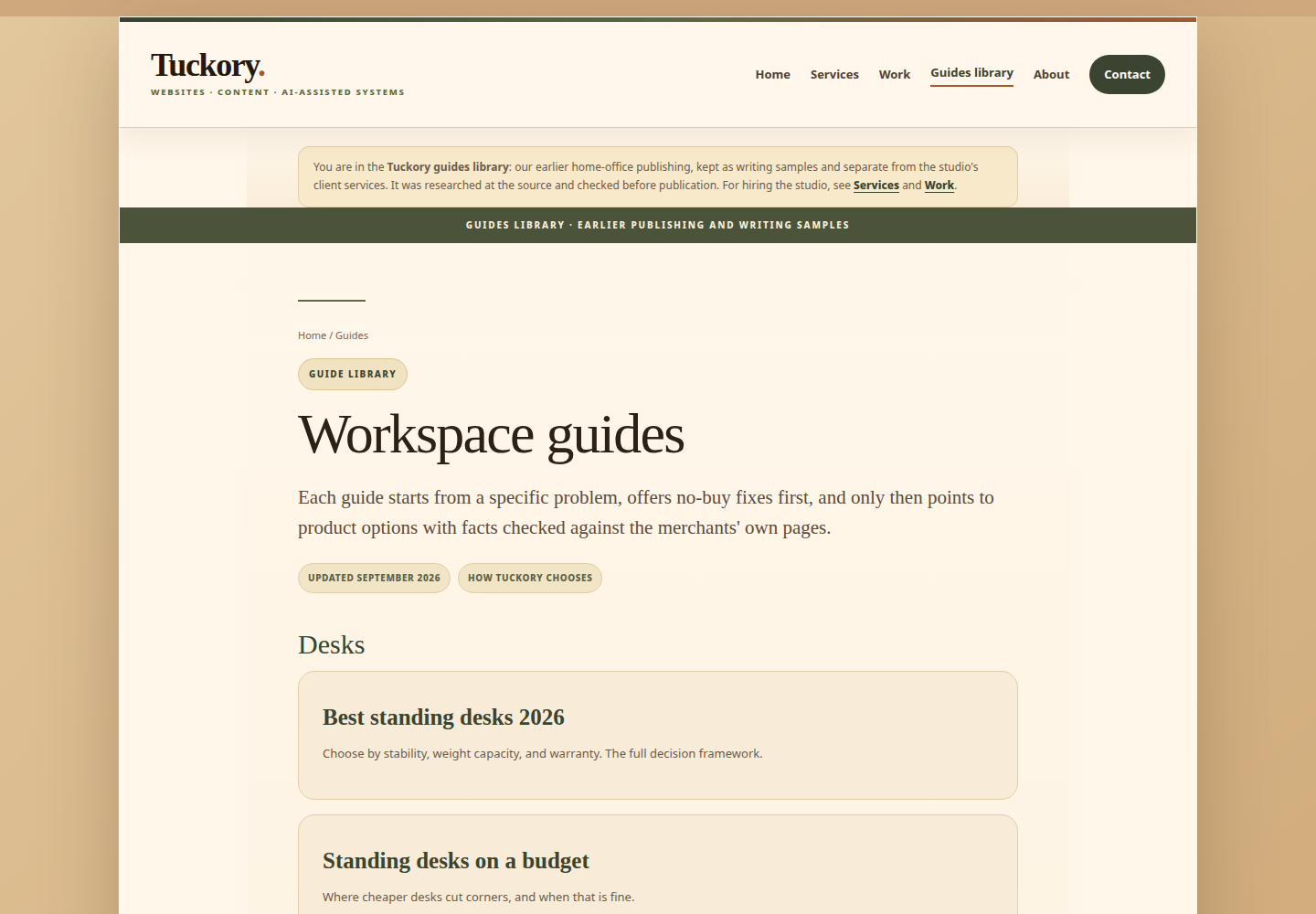
Screenshot of the Tuckory guides library page: a banner explaining the library is the studio's earlier home-office publishing kept as writing samples and separate from its client services, the "Workspace guides" heading with its method line, and the Desks section opening with "Best standing desks 2026" and "Standing desks on a budget."
The Tuckory guides library, the studio's earlier home-office publishing, kept on the site as writing samples and labeled separate from its client services. Each guide starts from a specific problem, offers no-buy fixes first, and checks its product facts against the merchants' own pages; the frame shows the Desks section.

Separate from client services, this is our earlier publishing library: eight buying guides, four side-by-side comparisons, and two decision tools about home-office furniture and ergonomics, written and published under our own name on this site.

The library was written to a strict standard: product facts checked against the merchants' own pages, no paid placements, and no claim to have tested anything we did not. It remains live as a writing sample of how this studio researches and writes, not as client work and not as a service offering.

  • 8 guides on desks, chairs, lighting, and setups
  • 4 comparisons on verified facts
  • 2 decision tools that run entirely in the visitor's browser

Browse the library · The standard behind it

What is not on this page, on purpose: no client logos, no testimonials, no revenue or traffic figures, and no results claimed for anyone else. When client work exists that we are free to show, it will appear here with its scope stated the same plain way.

Your project

Want work held to this standard?

Tell us what you are building. We will answer honestly, including if the honest answer is that we are not the right studio for it.

hello@tuckory.com